
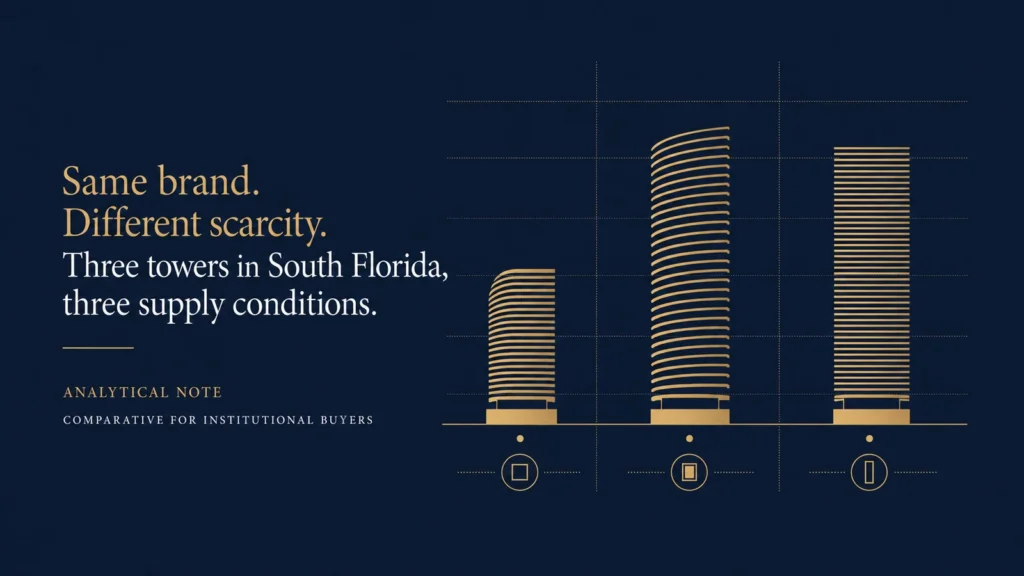
Three St. Regis towers, three different scarcities: what the brand premium buys in Sunny Isles
By Ariel Lima ·
Corridor analysis. Pre-construction pricing and comparable closings verified as of August 2026.
The brand is the same in all three towers. The St. Regis operating standard, the finish specification, the legibility of the name at resale: identical. On two of the three projects, even the architect is the same.
What is not the same — and what the brand premium does not buy — is scarcity.
A note on scope before the analysis. This practice covers one corridor: Sunny Isles Beach to Bal Harbour. Two of the three towers here sit outside it. They are present to test a method — the same framework run on three different supply conditions — not to extend coverage.
And the interest, by name, before any figure. This practice would earn a commission on a sale at St. Regis Residences Sunny Isles Beach, on a sale in any of the delivered Sunny Isles buildings cited as comparables in this analysis, and on a lease transacted through it in the corridor. The two towers outside the corridor are the only subjects here it would not be paid on. The reader should weigh that against everything below.
Asking prices per interior square foot, August 2026. The Sunny Isles and Bahia Mar figures are weighted averages calculated by this practice from the availability sheets cited below, each excluding that sheet’s highest-priced residence. The Brickell figure is not independently averaged here.
- St. Regis Bahia Mar, Fort Lauderdale — private residences: ~$2,089/SF
- St. Regis Residences, Miami (Brickell): ~$2,609/SF
- St. Regis Residences, Sunny Isles Beach — North Tower: ~$2,750/SF
The project with the most land, the most beach frontage and the greatest scale is the cheapest per interior foot. The brand did not set those prices.
This analysis measures each project against real 2026 closings in its own submarket, where any exist. The conclusion is inconvenient for the corridor this practice earns its living from: Sunny Isles ranks third. It publishes anyway, because a framework that systematically favors the author’s own inventory is not a framework. It is sales material.
What scarcity is, and what it is not
In branded pre-construction the word is used loosely, and it usually means two things that are not scarcity. It is not the unit count: a 150-residence building is no scarcer than a 320-residence building if the submarket can deliver another thousand comparables during the holding period. It is not sales velocity: absorption measures current demand, not a structural constraint on supply.
Scarcity, understood analytically, is the durability of the constraint: whether the thing limiting supply persists across the ten, fifteen or twenty years capital stays allocated. A sustainable brand premium rests on a constraint that outlives the investment horizon. A premium resting on a temporary constraint is simply launch pricing.
Axis 1 — Irreplaceable land. The site cannot be replicated by future supply: last oceanfront parcel, regulatory density constraint, a barrier-island position no comparable parcel matches.
Axis 2 — First-mover repositioning. The project is first of its category in its corridor. No comparable exists that can price its premium: the market has to reprice toward it rather than value it against something already delivered.
The combination test — the unpriced premium. The project looks expensive against current comparables precisely because it is going to become the comparable. A launch premium is a qualifying signal, not an alarm — but only when both axes are genuinely present.
The indispensable methodological rule: the test runs within a submarket, never across submarkets. Each submarket has its own ceiling, already demonstrated by delivered closings. A $/SF that constitutes a substantial premium in Fort Lauderdale may be at market in Sunny Isles. Comparing Broward against Miami-Dade does not measure scarcity. It measures geography.
Check 1 — Delivery reliability and sponsor. Check 2 — Availability on original launch basis. Pre-closing upside is only capturable on inventory that has not been repriced upward.
Three sites, three categories of constraint
| Sunny Isles Beach | Miami (Brickell) | Bahia Mar (Fort Lauderdale) | |
|---|---|---|---|
| Address | 18801 Collins Ave | 1809 Brickell Ave | 801 Seabreeze Blvd |
| Site area | 4.7 acres | ~3.16 acres | ~39 acres |
| Water frontage | 435 linear feet oceanfront | Bayfront (Biscayne Bay) | ~2,000 linear feet Atlantic beach + Intracoastal |
| Tenure | Fee simple | Fee simple | Ground lease on city-owned land |
| Program | 320 residences (South 170 / North 150), two towers ~62 floors | 152 residences, 50-floor tower | 239 for sale: 160 private (two 23-floor towers) + 79 Resort Collection |
| Projected delivery | South 2028 / North 2029 | 2027 | ~2029 |
| Sponsor | Fortune International Group + Château Group; Arquitectonica | Related Group + Integra; Robert A.M. Stern | Related Group + Tate Capital + Rok; Arquitectonica |
| $/SF interior, asking, Aug 2026 sheets | ~$2,750 (North Tower) | ~$2,609 | ~$2,089 (private) / ~$2,348 (Resort Collection) |
Averages calculated by this practice: Sunny Isles, sheet dated 12 August 2026 (13 units, $2,700–$2,853/SF); Bahia Mar private residences, August 2026 sheet (10 units, $4,945,625–$20,500,000). The counts and ranges describe the full sheets; each average excludes that sheet’s single highest-priced residence. Interior area. Prices subject to change without notice.
Brickell is not oceanfront. It sits on Biscayne Bay. That is not a weakness in the analysis — it is the analysis. Same brand, different land category, different scarcity.
Axis 1 — Irreplaceable land, and the distinction the price does not reveal
On site irreplaceability the ranking is direct. Bahia Mar controls ~39 acres with roughly 2,000 linear feet of Atlantic beach plus Intracoastal frontage. There is no second parcel of that scale and position available for assembly in South Florida. Sunny Isles operates on 4.7 acres and 435 linear feet; Brickell on ~3.16 acres of bay frontage.
But the Sunny Isles constraint does not come from parcel size. It comes from the municipal regulatory regime. The oceanfront is governed by the city’s Code of Ordinances, specifically §265-35, Mixed Use – Resort District (MU-R), which administers density, height, setbacks and the mechanisms for transferring and allocating density on oceanfront parcels. The practical consequence: additional net density on that frontage is regulatorily administered, not available by default. A future tower is not built on open land; it is built by repositioning a parcel already occupied by an operating asset, within what the district permits. That is a genuine and durable structural constraint.
The distinction the cover price does not reveal: site irreplaceability and the durability of the interest acquired are two different questions.
Bahia Mar sits on land owned by the City of Fort Lauderdale. The master lease was approved by Resolution No. 22-73 of the City Commission (file 22-0355), adopted 5 April 2022, effective 13 April 2022 per city memorandum. The approved structure is a 50-year base term plus a 50-year extension right, exercisable by the lessee and subject to the terms of the agreement. The extension is contingent, not automatic. At expiry the land remains with the City and improvements revert to it. The buyer acquires a leasehold interest in the unit for the term of the agreement — not ownership of the land.
Precision note: the expiry dates derived from that structure — 2072 for the base term, 2122 for the maximum — are calculated from the approved structure. They are not read from a recorded instrument this analysis has reviewed. The conditions governing exercise of the option, and the Broward County recording instrument number, are not verified here.
The arithmetic survives that imprecision. A buyer closing at delivery in ~2029 holds roughly 43 years of base term — comfortable against a 30-year mortgage. That same buyer, reselling in 2049 after twenty years of ownership, is offering an interest with roughly 23 years of base term remaining. That is the range in which leasehold financing narrows, and therefore the range in which exit liquidity is decided.
Axis 1 result: Bahia Mar leads decisively on site irreplaceability. Sunny Isles holds a durable regulatory constraint on fee simple. Brickell presents the weakest constraint: bay frontage in a densifying corridor is not structurally finite in the same way.
Axis 2 — measured against 2026 closings, where there is something to measure
| Project | $/SF asking, Aug 2026 | Delivered benchmark, 2026 closings | $/SF | Closings | Local premium |
|---|---|---|---|---|---|
| Sunny Isles, North Tower | ~$2,750 | Turnberry Ocean Club + Ritz-Carlton Sunny Isles | $1,956 | 4 | ~+41% |
| Brickell | ~$2,609 | Una Residences | $1,905 | 1 | ~+37% (n=1) |
| Bahia Mar, private | ~$2,089 | no category peer exists | — | 0 | not measurable |
Every figure for the three St. Regis projects is an asking price taken from a developer availability sheet; every comparable is a recorded closing. The premiums should be read with that difference in view.
Sunny Isles: the highest measured premium, with the weakest first-mover position. The ~+41% is measured against four 2026 closings at Turnberry Ocean Club and Ritz-Carlton Residences Sunny Isles — branded product, delivered, oceanfront, same submarket, varied floors. It is the most robust sample of the three comparisons.
Axis 2 is not satisfied. Sunny Isles is not first of its category in its corridor: Ritz-Carlton Residences, the Acqualina family and Turnberry Ocean Club have already priced the branded oceanfront segment in that submarket, and announced supply along the Collins Avenue corridor suggests additional future competition, not quantified in this analysis. The market prices St. Regis Sunny Isles against existing comparables; it does not reprice toward it.
The reading calibrated to the size of the evidence: this is an elevated premium against a limited comparable set, requiring validation against unit-level adjustment and against the corridor’s future supply before it is treated as a conclusion. It is not a demonstrated law about returns or downside protection. It is a hypothesis with its supporting evidence set out below. That said, the direction is clear: the tower with the highest measured premium sits in the corridor with the most future competition.
The number that weakens this conclusion, published in full. There is a higher tier of delivered product in Sunny Isles with substantially higher 2026 closings: Estates at Acqualina TS4205 at $2,823/SF, 17901 Collins 2004 at $2,469/SF, Estates at Acqualina N701 at $2,284/SF, 888 Via Acqualina N2401 at $2,144/SF. That tier sits one category above St. Regis in the corridor. Including it would compress the measured premium from ~+41% to roughly +20%. It was excluded from the primary comparison to hold the category peer constant.
Brickell: premium explained, on a single closing. The ~+37% is explained largely by the branded-versus-unbranded differential — Una Residences is not a branded project. Bayfront land scarcity is real, but the premium is already priced. It rests on a single transaction in the benchmark building, and one transaction is not a distribution.
Bahia Mar: the premium is not measurable with available closings. There is no delivered branded comparable in Fort Lauderdale matching on floor, size and typology. The only serious candidate — Four Seasons Fort Lauderdale — has exactly two recorded closings: unit 1902, floor 19 of a 22-floor building, six bedrooms, 4,516 SF with a private terrace-spa and marketed as a premier penthouse residence; and unit 1610, 729 SF, sold furnished, whose legal description corresponds to the condo-hotel component rather than a private residence. Neither serves as a benchmark against a blended average of floors 4 through 23. There is no third.
Both axes are satisfied and the combination test goes unmeasured — not failed, unmeasured. And that absence is itself the strongest Axis 2 evidence among the three projects: Bahia Mar does not enter a corridor, it creates one, and the proof is that Fort Lauderdale contains nothing to measure it against.
Delivered context, no premium computed. The only delivered high-floor branded transaction in that market that is not a penthouse is Ritz-Carlton Fort Lauderdale unit 2203, floor 22, 3,833 SF, closed 2 April 2026 at $1,226/SF. Built 2008 — the wrong vintage to anchor a premium against 2029 delivery, and one closing is not a distribution. But the reader should have the number in front of them: the only delivered high-floor branded closing in Fort Lauderdale prints at $1,226/SF, and Bahia Mar asks $2,089 blended, for 2029 delivery, on a ground lease. That differential is roughly 70%. It is not computed here as a premium. It is handed to the reader to weigh.
The floor rule: why almost no $/SF comparison is a comparison
In oceanfront product, a $/SF without floor, line and exposure is not a comparison.
Selene Oceanfront Residences closed two identical 3,240 SF units four months apart: $1,443/SF in March and $957/SF in July 2026. A 51% differential looks like a market collapse. It is not. The first is floor 19, four bedrooms; the second is floor 5, three bedrooms. Fourteen floors and a different typology.
The internal gradient within the same building, on identically sized lines and recorded closings, confirms it:
- 1,707 SF line: floor 25 $1,289 · floor 17 $996 · floor 12 $952 · floor 10 $879
- 1,416 SF line: floor 18 $1,148 · floor 10 $865 · floor 9 $872 · floor 7 $862
Fifteen floors produce a 47% differential within the same line, the same building and the same year. A 51% spread across fourteen floors is exactly what this building does.
A building-average $/SF in an oceanfront tower describes no unit in that building.
Elevation is not the only variable, nor necessarily the largest. The Bahia Mar sheet shows that the same interior area can carry radically different exterior area: the Residence 01 line delivers 1,286 SF of terrace; the Residence 02 line, 284 SF. A $/SF calculated on interior area treats both as equivalent. They are not. Line and exposure carry as much price as height.
Unit size introduces a third distortion, and the Four Seasons annex demonstrates it: a 729 SF unit closed at $1,818/SF, barely 12% below a 4,516 SF penthouse in the same building, despite six times the size difference and a top-floor position. Small units carry higher $/SF for equivalent position, which compresses a differential that should be far wider. Floor, line, exposure and size all move the figure. A blended average absorbs all four.
Pre-construction and resale do not price on the same logic
From the preceding rule comes an observation that extends beyond these three projects, and it is the most transferable thing in this analysis.
Pre-construction: the 12 August sheet for St. Regis Sunny Isles North Tower covers thirteen units between floors 11 and 49, in a range of $2,700 to $2,853/SF. A 5.7% differential across thirty-eight floors. Bahia Mar publishes its Residence 01 and Residence 02 as single plan types spanning floors 3 to 23; the available units on the August sheet begin at floor 4, which is why the blended figure above covers floors 4 through 23. Within the 02 line, that sheet runs from $1,894/SF on floor 4 to $2,210/SF on floor 18 — 17% across fourteen floors.
Delivered resale: Selene produces a 47% differential across fifteen floors, within the same line and the same year.
The developer sells the floor plan. The resale market prices the view. The height gradient in pre-construction is compressed — in one case nearly eliminated — against what the secondary market actually pays for elevation.
An allocator buying pre-construction buys at a price that does not yet reflect what resale will pay for height. It cuts both ways: it favors the buyer who goes high and penalizes the buyer who goes low, and it is a structural feature of the category that almost no buyer has explained to them.
One limit worth naming once: precisely because pre-construction prices nearly flat by floor, the blended figures this analysis uses for the three St. Regis projects are representative of their inventory, in a way a blended resale average would not be.
The two checks
Check 1 — no differentiation in this group, except on one point. All three projects have first-tier sponsors: Fortune International Group and Château Group in Sunny Isles, with $418M in financing and the precedent of having delivered Ritz-Carlton Residences Sunny Isles; Related with Integra in Brickell and $527M; Related with Tate Capital and Rok on a $2 billion project at Bahia Mar. Completion risk is low across all three. A check that never fails is a check the reader stops taking seriously.
Where it does differentiate is on durability of interest: at Bahia Mar, the conditions under which the 50-year extension option is exercised remain unverified. The right sits with the lessee, subject to terms this analysis has not read. It is a matter of public record and of independent legal review before capital is committed.
Check 2 — here there is clear separation.
Brickell: fewer than 10 residences of 152 available per the developer’s January 2026 statement, confirmed by public reporting in August 2026. Demonstrable absolute scarcity, entry window closed, price already stepped up.
Sunny Isles: the South Tower reported ~90% presold as of December 2025. The North Tower is a separate phase, launched in 2024 in a $4.5M–$15M range; the 12 August 2026 sheet shows $5.0M–$19.0M. The North Tower no longer prices on its own launch basis.
Bahia Mar: release scarcity, not demonstrable sales scarcity. The August sheets show 18 units against a 239-unit program. That is released inventory, not unsold inventory; the developer releases in controlled tranches. It is not defensible to derive an absorption percentage from that figure, and this analysis does not.
One note the reader will notice: the Resort Collection prices higher per foot (~$2,348) than the private residences (~$2,089). They are smaller units, delivered furnished, with a rental policy permitting nightly, weekly or long-term leasing without blackout dates — against a six-month minimum in the private residences.
Closing velocity: the question price does not answer
A closing price says how much was paid. It does not say how long it took or what the seller conceded. For an allocator the question is not “what did it sell for?” but “can I get out, in what period, and at what concession?”
Spread between asking price and closing price, on the same verified 2026 transactions:
| Submarket | Unit | Ask → Close |
|---|---|---|
| Sunny Isles | Turnberry Ocean Club 4504 | +4.3% (above ask) |
| Sunny Isles | Ritz-Carlton 3701 | −2.9% |
| Sunny Isles | Turnberry Ocean Club 1001 | −6.0% |
| Sunny Isles | Ritz-Carlton 4203 | −7.2% |
| Brickell | Una Residences 1601 | 0.0% (full ask) |
| Fort Lauderdale | Four Seasons 1902 (penthouse) | −7.0% |
| Fort Lauderdale | Selene, March | −6.5% |
| Fort Lauderdale | Selene, July | −8.8% |
| Fort Lauderdale | Ritz-Carlton 2203 | −21.6% |
Sunny Isles closes between −7.2% and above ask, with one unit above ask. Fort Lauderdale concedes between 6.5% and 21.6%. Brickell closed at full ask, on a single transaction.
Four of these nine closings sit in the corridor this practice covers. Nine transactions across three submarkets do not constitute a market distribution.
The net: why the gross price is not the deciding figure
An allocator reasons in cost after friction. An exercise on a single unit shows where the information is and where it is not.
Bahia Mar residence 402: 2,611 interior SF, $4,945,625 on the August sheet. The published association fee for private residences is $2.00/SF — understood here as a monthly fee, the standard convention for South Florida luxury product, though the developer’s own documents govern — producing roughly $5,222 monthly, $62,664 annually, before any other component.
The other two principal components are not calculable today, and that is itself the conclusion. Property tax is determined by applying the prevailing millage rate to assessed value, and that value does not exist until the asset is delivered and the county appraiser records it. Insurance is billed as an allocation of the association’s master policy, and that policy is not placed until the building exists. A buyer with 2029 delivery commits capital today against a holding cost that is set three years later.
Two further frictions apply where the buyer is not a US person for tax purposes: withholding under FIRPTA on sale, and US estate tax treatment of US-situs assets. Both require counsel and an accountant with the specific tax residency in view; quantifying them generically would be false precision. Where the buyer is a US person, neither applies, and the net figure is correspondingly simpler.
What an allocator should take away: in pre-construction, a substantial part of the net cost of ownership is unknown at the moment capital is committed. That is not a defect of this project. It is a feature of the category, and it rarely appears in sales material.
Insurance and climate exposure
Florida’s condominium insurance crisis is not a single problem, and conflating its components leads to wrong conclusions about new product. Older towers carry two costs simultaneously: the statewide cost of coastal windstorm insurance, and a balance-sheet correction for aging systems, deferred maintenance and historically underfunded reserves. A new tower largely eliminates the second and materially improves the first. It does not eliminate the underlying catastrophe exposure: coastal location, replacement value, hurricane models and reinsurance pricing continue to determine a substantial portion of the master policy.
A necessary precision: a tower delivered in 2028 or 2029 is not exempt from the reserve law. Buildings of three or more habitable stories require a structural integrity reserve study (SIRS) at least every ten years from creation, and an association under developer control cannot vote to waive or reduce reserve funding before turnover. Milestone inspections begin at 30 years, or at 25 where the local authority invokes the coastal provision. A new tower starts the clock at zero; it is not exempt from it.
The second point is mechanical and almost never explained. Coastal master policies operate with percentage deductibles for hurricane or named storm, not fixed figures, with the calculation base and triggering event varying by policy. Allocation percentages are set in the condominium declaration, and associations differ in whether they fund that retention from reserves or by special assessment. It is not a trap: a percentage retention against catastrophe loss is ordinary. What is notable is that a sales brochure never explains it, and that two buildings with identical headline deductibles can distribute the cost very differently.
And a correction worth making, because the headlines suggest the opposite: the catastrophe reinsurance market is softening, not hardening. Aon described mid-2026 property-catastrophe renewals as highly competitive, with double-digit reductions; Howden reported risk-adjusted decreases of up to roughly 25% at the 1 June 2026 renewal.
Why scarcity does not close the decision
This framework ranks projects by durability of constraint. It does that job well and it does no other.
What it cannot say: how the service standard actually operates once the building is delivered, what the real resident profile is, whether the amenity program is used or ornamental, how management behaves in the third year, how the building performs in hurricane season. Pre-construction is the only purchase category in which none of that is observable before committing. The buyer signs, deposits, and waits three to five years to discover whether they paid for an operating standard or a logo.
The recommendation that follows is one this practice is paid on, as stated at the top. The order still stands, and here is why.
Living twelve months oceanfront in the corridor before buying converts the waiting period into direct observation: management, service culture, resident profile, the building’s seasonal behavior and real construction quality. It is the one body of evidence no price analysis substitutes for, and it is obtained without committing purchase capital. Scarcity analysis narrows the field; occupancy confirms whether the premium is real before it is paid.
Decision framework
A brand premium in pre-construction has structural support when:
- The supply constraint is regulatory or geographic rather than cyclical, and outlives the holding horizon
- The project is first of its category in its own submarket, measured against delivered comparables in that submarket
- The interest acquired is fee simple, or the remaining base term comfortably exceeds the projected resale horizon
- Available inventory remains on original launch basis
- The sponsor has delivered precedent in the same submarket
On the three projects: Bahia Mar leads on site scarcity, with both axes satisfied and the combination test unmeasured for want of a category peer in its market — plus a tenure qualification a capital-preservation allocator must evaluate separately. Brickell presents demonstrable absolute scarcity and a closed entry window. Sunny Isles offers fee simple on a durable regulatory constraint, with the highest measured premium and the weakest first-mover position of the three.
A scarcity ranking is not an allocation ranking. Scarcity is one input; tenure is another. Horizon, tax residency, ownership structure and intended use are further inputs this framework does not weight, and they determine the final decision.
The relative weights of each dimension, and the thresholds by category, are not published. The transactions the analysis is built on are — they are set out below, in full.
Annex — comparable transactions
Closings recorded in the MLS during 2026. Living area. No hedonic adjustment for floor, orientation, view or condition.
Sunny Isles Beach — category peer set (4 closings, weighted average $1,956/SF)
| Building | Unit | Closed | Price | SF | $/SF |
|---|---|---|---|---|---|
| Turnberry Ocean Club | 4504 | 10 Mar 2026 | $7,200,000 | 3,625 | $1,986 |
| Turnberry Ocean Club | 1001 | 29 May 2026 | $6,535,000 | 3,625 | $1,803 |
| Ritz-Carlton Residences (15701 Collins) | 3701 | 2 Mar 2026 | $6,100,000 | 3,080 | $1,981 |
| Ritz-Carlton Residences (15701 Collins) | 4203 | 26 Feb 2026 | $3,200,000 | 1,447 | $2,211 |
Sunny Isles Beach — trophy tier (excluded from the primary calculation)
| Building | Unit | Closed | $/SF |
|---|---|---|---|
| Estates at Acqualina | TS4205 | 30 Jun 2026 | $2,823 |
| 17901 Collins | 2004 | 27 Apr 2026 | $2,469 |
| Estates at Acqualina | N701 | 31 Mar 2026 | $2,284 |
| 888 Via Acqualina | N2401 | 25 Jun 2026 | $2,144 |
Brickell (1 closing)
| Building | Unit | Closed | Price | SF | $/SF |
|---|---|---|---|---|---|
| Una Residences (175 SE 25th Rd) | 1601 | 17 Jul 2026 | $4,000,000 | 2,100 | $1,905 |
Fort Lauderdale — no valid category peer
| Building | Unit | Closed | Price | SF | $/SF | Note |
|---|---|---|---|---|---|---|
| Four Seasons (525 N Fort Lauderdale Beach Blvd) | 1902 | 15 Apr 2026 | $9,300,000 | 4,516 | $2,059 | Premier penthouse, floor 19 of 22 — not representative |
| Four Seasons (525 N Fort Lauderdale Beach Blvd) | 1610 | 28 Apr 2026 | $1,325,000 | 729 | $1,818 | Condo-hotel component, sold furnished |
| Ritz-Carlton (1 N Fort Lauderdale Beach Blvd) | 2203 | 2 Apr 2026 | $4,700,000 | 3,833 | $1,226 | Built 2008 — vintage not comparable |
| Selene Oceanfront (153 N Seabreeze) | 1902-S | 24 Mar 2026 | $4,675,000 | 3,240 | $1,443 | 2025, unbranded, floor 19 |
| Selene Oceanfront (153 N Seabreeze) | S-502 | 17 Jul 2026 | $3,100,000 | 3,240 | $957 | 2025, unbranded, floor 5 |
Regulatory and verification sources
- City of Sunny Isles Beach, Code of Ordinances §265-35, Mixed Use – Resort District (MU-R) — density, height, setbacks and oceanfront density administration (Municode, codified through June 2025)
- City of Fort Lauderdale, Resolution No. 22-73 (file 22-0355), adopted 5 April 2022 — Bahia Mar master lease
- Florida Statutes §718.503 — mandatory developer disclosure in pre-construction
- Florida Statutes §718.112 — structural integrity reserve study, §718.112(2)(g); reserve regime and prohibition on waiver before turnover, §718.112(2)(f)
- Florida Statutes §553.899 — milestone inspection
- Florida Statutes §627.701 — deductibles and insured responsibility
- Aon and Howden — catastrophe reinsurance renewal reports, June and July 2026
The relative weights are withheld because they depend on a mandate this analysis does not have. If you are weighing a specific residence in the corridor — or a pre-construction contract against a delivered alternative — send the building and the line and the framework runs against your horizon rather than against an average.
Pre-construction figures calculated from availability sheets current in August 2026, verified directly with the developers; subject to change without notice. Comparables are closings recorded in the MLS in 2026. This document is market analysis and does not constitute legal, tax or investment advice. No performance projection is implied and none should be inferred.
The monthly corridor analysis. One a month.